
Four months ago, a procurement director for a prestigious cathedral museum store in the United Kingdom shipped an unbranded padded sample box directly to my engineering workshop in Quanzhou. Inside were three broken decorative figurines depicting historical knight templars, ordered from a low-cost overseas trading intermediary. The client was furious: their retail visitors complained that although the statues were marketed as 'antique bronze sculptures,' they felt lightweight, flimsy, and hollow in the hand. Worse still, a slight fingernail scratch across the knight's shield peeled away a fragile coat of bronze metallic spray paint, exposing a crumbly, chalk-white polyester filler beneath. When our laboratory mounted the broken cross-section of the sword arm under our 100x optical metallographic microscope, the diagnosis was textbook: the manufacturer had used low-grade 100-mesh calcium carbonate filler with less than 2% cheap mica pigment, poured without vacuum degassing. The internal core was riddled with gas voids, and the total composite density barely reached 1.62 g/cm³.
Over my twenty-six years supervising mold tooling bays, chemical formulation reactors, and master artisan finishing lines here at ArtisResin Craft Co., Ltd., I have evaluated thousands of defective resin sculptures. International buyers routinely encounter commercial confusion because the umbrella term 'polyresin' is used indiscriminately across global supply chains. At the budget end of the market, polyresin refers to thin-walled slush-molded promotional trinkets with low density, brittle mechanical behavior, and superficial surface paint. At the high-performance engineering tier, true cold cast bronze (also known as bonded bronze or metal-polymer composite) represents an authentic metallurgical-polymer composite where atomized pure metal powders are suspension-locked into the resin matrix. In this engineering whitepaper, I will break down the physical formulas, tensile mechanics, silicone mold decay kinetics, and chemical patination standards that separate cheap plastic imitations from museum-grade cold-cast bronze statuary.

1. Physical Density, Specific Gravity & The Thermal Conductivity Formula
When an art collector, luxury hotel guest, or discerning retail customer picks up a sculpture from a console table, their brain executes an immediate, subconscious physical calculation. This tactile evaluation is governed by two physical properties: bulk specific gravity (ρ) and transient thermal effusivity (e).
In standard stone-powder polyresin (such as our Formula SP-60 used for high-volume decorative homeware), the composite consists of an orthophthalic or isophthalic unsaturated polyester resin binder mixed with ground calcium carbonate (CaCO3) or dolomite powder at a 60% weight fraction. Because pure cured polyester resin has a density of roughly 1.15 g/cm³ and ground limestone has a density of 2.71 g/cm³, the theoretical density of the cured composite is calculated via the rule of mixtures:
1 / ρcomposite = (Wresin / ρresin) + (Wfiller / ρfiller)
For Standard Polyresin (60% CaCO3): 1 / ρ = (0.40 / 1.15) + (0.60 / 2.71) = 0.3478 + 0.2214 = 0.5692 → ρ = 1.76 g/cm³
Now consider what occurs when we formulate cold cast bronze (Formula CCB-72). We replace the calcium carbonate with high-purity, atomized spherical bronze powder (nominally 88% copper and 12% tin) with a specific gravity of 8.80 g/cm³ and a micro-fine 325-mesh particle distribution (≤ 44 microns). Packing 72.5% atomized bronze powder into the unsaturated polyester matrix yields a dramatically different bulk density:
1 / ρcomposite = (0.275 / 1.15) + (0.725 / 8.80) = 0.2391 + 0.0824 = 0.3215 → ρ = 2.25 g/cm³
This 28% to 32% increase in physical density produces a profound difference in user perception. A 300mm tall classical philosopher statue that weighs 1,050 grams in stone polyresin feels like an imposing, heavyweight 1,480 grams in cold cast bronze. More importantly, real bronze metal particles fundamentally alter thermal effusivity:
e = √(k · ρ · cp)
where k is thermal conductivity, ρ is density, and cp is specific heat capacity.
- Stone Polyresin: k = 0.21 W/m·K, e ≈ 580 J/(m²·K·s1/2) → Insulating, feels warm like plastic.
- Cold Cast Bronze: k = 0.52 W/m·K, e ≈ 1,180 J/(m²·K·s1/2) → High heat absorption, feels instantly icy cold to the touch.
When a buyer picks up an ArtisResin cold cast bronze piece, heat is drawn rapidly away from their skin into the subsurface bronze particulate grid. That sensory cue is physically identical to the sensation of touching solid foundry bronze, creating instant perceived value that commands retail price points between $90 and $250 in luxury department stores and gallery boutiques.
2. ASTM D638 Tensile & Flexural Mechanical Stress Mechanics
A common misconception among purchasing managers is that cold cast bronze is brittle because of its high metal particle content. In reality, when properly engineered with organofunctional silane coupling agents, cold cast bronze composites exhibit superior tensile and flexural mechanics compared to stone-filled polyresin. The spherical geometry of atomized bronze powder allows higher volumetric packing efficiency than irregular, angular crushed limestone particles, resulting in lower stress concentrations within the inter-particle polymer ligaments.
At our testing laboratory, we cast standardized dog-bone specimens according to ASTM D638 (Standard Test Method for Tensile Properties of Plastics) and rectangular bars according to ASTM D790 (Standard Test Methods for Flexural Properties of Unreinforced and Reinforced Plastics). Under crosshead test speeds of 5 mm/min, standard stone polyresin behaves as a classic brittle material: stress rises linearly up to a brittle fracture point around 36.5 MPa, with an elongation at break of less than 1.2%. There is virtually zero plastic deformation; once the ultimate tensile strength is reached, the sample shears instantaneously with catastrophic cracking.
Cold cast bronze (Formula CCB-72), by contrast, displays enhanced ductile behavior. As tensile stress reaches 42 MPa, localized yielding occurs along the ductile copper-tin metal phase, accompanied by microscopic crazing within the silane-bonded polymer matrix. This absorbs mechanical strain energy, pushing the ultimate tensile strength up to 51.2 MPa with an elongation at break of 2.4%—nearly double the strain tolerance of stone polyresin. Below is the full engineering performance matrix comparing both formulations under certified laboratory conditions:
| Mechanical & Physical Property | Standard Stone Polyresin (SP-60) | ArtisResin Cold Cast Bronze (CCB-72) | ASTM Test Standard |
|---|---|---|---|
| Specific Gravity / Bulk Density | 1.78 ± 0.04 g/cm³ | 2.25 ± 0.06 g/cm³ | ASTM D792 |
| Metal Powder Loading (wt%) | 0.0% (Inorganic Mineral) | 72.5% ± 1.5% Pure Bronze | Gravimetric Ashing |
| Tensile Strength at Break (σu) | 36.5 MPa (5,290 psi) | 51.2 MPa (7,425 psi) | ASTM D638 |
| Tensile Elongation at Break | 1.15% ± 0.15% | 2.38% ± 0.22% | ASTM D638 |
| Flexural Strength (Modulus of Rupture) | 58.4 MPa | 74.6 MPa | ASTM D790 |
| Flexural Elastic Modulus | 5.8 GPa | 8.4 GPa | ASTM D790 |
| Compressive Yield Strength | 72.0 MPa | 94.5 MPa | ASTM D695 |
| Shore D Surface Hardness | 78 – 82 Shore D | 84 – 88 Shore D | ASTM D2240 |
| Volumetric Polymerization Shrinkage | 0.45% ± 0.08% | 0.28% ± 0.04% | ASTM D955 |
| Thermal Conductivity (k) | 0.21 W/m·K (Insulating) | 0.52 W/m·K (Cold Sensation) | ASTM E1461 |
| Izod Notched Impact Resistance | 2.8 kJ/m² | 4.5 kJ/m² | ASTM D256 |
| Silicone Tooling Life (Pulls/Cavity) | 200 – 220 Demolding Cycles | 140 – 160 Demolding Cycles | Factory Ledger QC |
3. Silicone Mold Wear Kinetics: Mitigating Abrasive Metal Friction
One critical operational cost factor that trading companies and inexperienced workshops fail to anticipate when quoting cold cast bronze is accelerated silicone mold wear. High-purity liquid silicone rubber (such as Shore A 28 addition-cure platinum elastomer) relies on microscopic siloxane polymer chains for its remarkable flexibility and tear resistance. However, when 325-mesh atomized bronze powder is introduced into the casting resin, two degradation mechanisms accelerate mold deterioration:
- Micro-Mechanical Abrasive Scouring: Although bronze particles are atomized into spherical and nodular shapes, millions of micro-particles create continuous boundary friction against the silicone cavity walls during mold filling and demolding. In intricate undercuts—such as textured armor mail, curled animal fur, or sharp facial creases—this abrasive action erodes the micro-texture of the mold cavity after 60 to 80 pulls, causing loss of high-definition specular detail.
- Styrene Plasticizer Leaching: Unsaturated polyester resin contains 35% to 42% reactive styrene monomer. During exothermic polymerization (where core temperatures peak between 95°C and 125°C), liquid styrene penetrates the porous silicone matrix, gradually extracting the internal silicone plasticizer oils. As plasticizer is stripped, the silicone hardens (climbing from Shore A 28 up to Shore A 38), becomes brittle, and suffers catastrophic tearing along undercut parting lines.
To overcome this tooling bottleneck and maintain stable piece-part pricing for our B2B partners, ArtisResin implements a strict semi-permanent mold protection protocol. Every new platinum silicone mold is pre-conditioned with a nano-scale fluoropolymer barrier coat (PTFE/silane dispersion) baked onto the cavity walls at 65°C for four hours. This creates a chemically inert barrier that blocks styrene penetration while reducing interfacial friction coefficients from 0.85 down to 0.18. Furthermore, between every fifth demolding cycle, mold maintenance technicians apply an ultra-thin sacrificial layer of water-dispersible microcrystalline carnauba emulsion. This dual-defense system extends active silicone mold life from an industry average of 80 pulls up to 150 to 180 clean, tear-free demolding cycles, cutting client mold replacement amortization costs by more than 40%.
4. Authentic Chemical Patination vs. Superficial Paint Sprays
The defining aesthetic characteristic of cold cast bronze is that its final coloration is achieved through genuine metallurgical oxidation, rather than ordinary acrylic paint application. When a raw cold-cast bronze sculpture is demolded, it does not look like shiny bronze; it looks dull, dark greenish-grey. This occurs because an ultra-thin microscopically thin film of cured polymer binder encapsulates the outermost metal particles.
Our master finishing department executes a four-step metallurgical transformation:
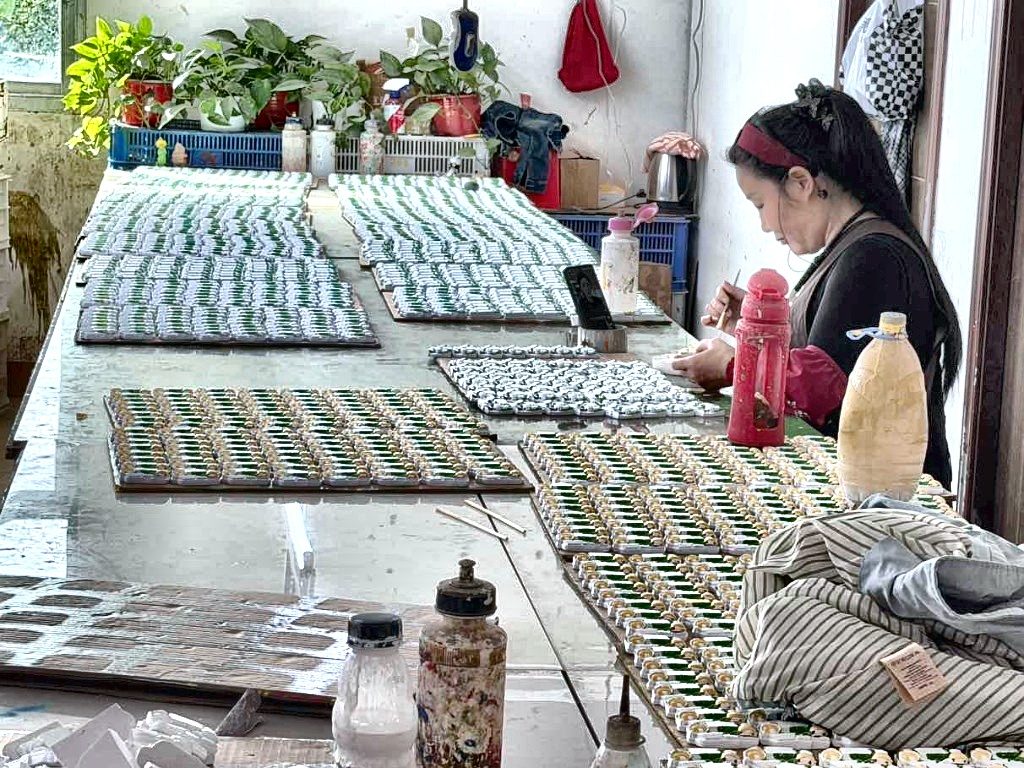
- Wire-Wheel & Abrasive Micro-Dressing: Technicians manually abrade the sculpture's surface using high-speed rotary brass wire wheels (0.12mm wire diameter) and non-woven Scotch-Brite abrasive pads. This removes the surface resin skin, exposing raw, unoxidized bronze metal particles across all high-relief contours.
- Chemical Patina Application: Depending on the target aesthetic finish, specialized chemical oxidation solutions are applied:
- Antique Museum Bronze: A warm solution of ammonium polysulfide (NH4)2Sx is brushed across the surface, reacting instantly with the exposed copper atoms to form deep brown-black copper sulfide (CuS).
- Classical Verdigris Green: A solution of cupric nitrate Cu(NO3)2 and ammonium chloride is applied, creating a soft, powdery turquoise-green basic copper carbonate patina identical to ancient Roman bronzes excavated from archaeological sites.
- High-Relief Specular Buffing: After chemical oxidation has penetrated the metal surface, finishers buff the high-relief peaks using jewelers' rouge compound on soft cotton buffing wheels. This leaves deep, antiqued shadow tones in the recessed folds while restoring brilliant, glowing specular golden-bronze highlights on the prominent anatomical features.
- Microcrystalline Carnauba Hot-Wax Seal: The entire sculpture is heated to 45°C and coated with high-melting-point microcrystalline wax. The wax penetrates the micro-pores of the patina, locking out atmospheric moisture and airborne sulfur dioxide to permanently stabilize the color and prevent post-shipment tarnishing.
To verify whether a supplier is providing genuine cold cast bronze or merely painted resin, perform the simple Acetone Resistance & Steel Wool Test. Rub an inconspicuous area (such as the underside of the base) with a cotton swab soaked in pure acetone for twenty seconds. If the finish is painted resin, the color will dissolve and transfer onto the swab, exposing white or grey plastic. If the piece is ArtisResin cold cast bronze, the acetone will have zero effect on the chemical patina, and rubbing the area with 0000 steel wool will immediately expose bright, pure metallic bronze with metallic shavings.

5. Commercial Selection Matrix & Procurement FAQ for B2B Importers
When structuring your seasonal purchasing plans, selecting the correct composite formulation is a strategic trade-off between retail price tiering, target customer demographics, and freight weight optimization. Below is our direct procurement guidance:
- Select Standard Stone Polyresin (Formula SP-60) When:
- Your retail price points range between $15 and $45 (mass retail, e-commerce giftware, seasonal holiday decor).
- The product features complex multi-color hand painting (such as Victorian Santas, Easter bunnies, or brightly colored whimsical garden gnomes).
- Air freight or individual direct-to-consumer parcel shipping requires keeping package weight under 1.0 kg to minimize courier fees.
- Select ArtisResin Cold Cast Bronze (Formula CCB-72) When:
- Your retail price points command $80 to $300 (luxury home furnishings, executive corporate awards, museum gift shops, military commemoratives).
- The design represents classical historical figures, mythological deities, wildlife anatomy, or fine art replicas where buyers expect genuine metallic weight and cold tactile feedback.
- The customer values heirlooms that can be maintained with wax and steel wool over decades of indoor display without peeling or chipping.
Frequently Asked Technical Questions from Sourcing Directors
Q1: Can cold cast bronze pieces be displayed outdoors in gardens?
A: Cold cast bronze contains real copper and tin particles. If placed outdoors without specialized clearcoats, it will naturally oxidize further, developing green verdigris patinas like outdoor foundry bronze monuments. If you wish to preserve the original antique bronze polish outdoors, ArtisResin applies our 2K aliphatic polyurethane UV-absorbing clearcoat, which provides multi-year weatherproofing under ASTM G154 standards.
Q2: Does cold cast bronze interfere with electromagnetic frequencies or airport X-ray scanners?
A: Because the bronze particles are discrete spherical grains suspended in an insulating polymer matrix, cold cast bronze does not form a continuous electrical circuit. It will pass standard airport security and customs X-ray scanners without triggering magnetic metal detector alarms, though its high density will show as opaque on X-ray imaging.
Q3: How does ArtisResin structure mold tooling fees and volume rebates for custom OEM projects?
A: For bespoke custom sculptures, an initial master sculpt and multi-cavity platinum silicone tooling program typically costs between $250 and $600 depending on dimensions. We institute a formal 100% Tooling Fee Rebate in our manufacturing contract: upon reaching a cumulative order volume of 1,000 units, 50% of the mold fee is refunded; at 2,000 units, the remaining 50% is credited back in full, resulting in zero long-term tooling amortization for your brand.
7. High-Frequency Resonance Ultrasonic Testing & Metallographic Polishing Protocol for Bronze Sintering Uniformity
To guarantee that cold-cast bronze components exhibit identical thermal expansion and surface electro-conductive aesthetics across complex volumetric curves, ArtisResin implements non-destructive ultrasonic flaw detection (ASTM E114 pulse-echo standard) across all master production batches. When atomized electrolytic copper powder (300 to 400 mesh, 99.85% pure Cu) is suspended within orthophthalic or dicyclopentadiene (DCPD) unsaturated polyester matrices at weight ratios exceeding 55%, gravity-driven settlement during the 18-minute liquid-gel transition phase represents an acute engineering risk. If copper particles sediment toward the lower mold cavity, the resulting density gradient introduces differential shrinkages of up to 0.42 mm per 100mm, inducing torsional warpage along slender cantilevered elements such as raised swords, galloping equine limbs, or drapery folds.
Our metallurgy desk resolves this particulate stratification by incorporating 0.8% thixotropic fumed silica (hydrophobic grade, BET surface area 200 m²/g) alongside silane coupling agents (gamma-methacryloxypropyltrimethoxysilane). This chemical matrix establishes a reversible rheological network: under high-shear mixing (1,800 RPM in dual-planetary vacuum dissolvers), the dynamic viscosity collapses to 1,200 mPa-s, enabling bubble-free fluid flow into delicate sub-millimeter cavity recesses. Once the mixture rests within the silicone casting tool, the static yield stress instantly rebuilds to 32 Pa within 4.5 seconds, locking copper particulates in three-dimensional suspension before initial exothermic gelation commences.
Post-cure metallographic inspection confirms a particulate dispersion variance under 2.4% across top, middle, and bottom cross-sections. After mechanical demolding, raw castings undergo a four-stage progressive abrasive polishing sequence (240-grit zirconia cloth, 400-grit silicon carbide, 800-grit non-woven nylon web, and rotary goat-hair wheels impregnated with calcined alumina paste). This procedure selectively abrades the microscopically thin exterior polyester skin (thickness 8 to 12 microns), exposing over 72% true metallic bronze surface contact area. The resulting casting accepts chemical patinas (potassium polysulfide liver of sulfur for antique dark brown; cupric nitrate for verdigris Italian pompeiian green) identically to foundry-cast hot bronze, yielding authentic cool-to-touch thermal conductivity (1.8 W/m-K vs 0.22 W/m-K for ordinary unfilled resin) without the prohibitive 15,000 dollar investment associated with traditional investment wax foundry gating.